A Birthday Journey Across New York City That Defied All Logic
A Birthday Journey Across New York City That Defied All Logic
This essay is a blend of every part of me—my childhood love of drawing, the New York moments I collected with my grandmother, my hunger for adventure, my willingness to take a risk, and the Thanksgiving traditions that anchor our family.
We had all gathered in Manhattan to celebrate the holiday—and my birthday. The forecast promised cold and rain as Sherri and I stepped out of our hotel, flagged down a cab, and started what we believed would be a simple forty-block trip.
Sometimes the Road Less Traveled starts with something small—like a rising sense of fear over something that should have been simple. All we wanted was a traditional yellow cab with a meter, not an unmarked car with a vague promise of about twenty dollars. So when a real cab pulled up within minutes, we relaxed. For about ten seconds.
Then I noticed we were headed the wrong way.
I know that part of Manhattan by heart, and within a few blocks my internal compass started shouting. I finally asked the driver why we were going downtown when we should’ve been going uptown. He assured me—cheerfully—that his GPS said the destination was three miles.
Three miles? The entire island is about ten miles long, and our destination was half a mile from the hotel. That’s when the mental anguish kicked in.
He offered to let us out. He offered to follow our directions. But the language barrier was working against us, so in a moment of panic and politeness we said the fateful words:
Just listen to Siri.
And with that, every block felt wrong. The street names weren’t familiar, the landmarks refused to appear, and the city outside the window started to look less like Midtown and more like a scavenger hunt we hadn’t signed up for. By the time we realized we were nowhere heading toward Central Park—one place every taxi driver should be able to find—we knew this ride was turning into something entirely different than a routine cab trip.
Forty blocks later, the situation went from confusing to disastrous. That’s when we finally realized why the city felt so unfamiliar: every street around us was barricaded for the Thanksgiving Day Parade. Overnight crews had already sealed off entire avenues, and one by one, each turn we attempted was met with a uniformed arm waving us away. Every denial added another ten blocks to this increasingly absurd detour.
The driver kept glancing back at us in the mirror with a look that hovered somewhere between apology and total bewilderment. And at that point, we did what any sane people would do—cut our losses. Let us out here, we said, almost in unison.
We paid the ridiculous fare—at this point it felt like a ransom—but stepping onto the sidewalk felt like freedom. Fifteen blocks still separated us from our destination, but at least now we were the ones choosing the direction.
Manhattan has a population of about 1.6 million people, and I was fairly certain we were about to meet at least half of them—their children, their dogs, their strollers, and their full-throttle New York attitudes. As we headed toward our destination, we were denied once again. This time the officers blocking the streets offered warm smiles and polite apologies, but absolutely no grace. The barricades might as well have been stone walls.
Earlier that week I’d read an essay by Andy Rooney, who joked that New Yorkers don’t just like to win—they have to win. At everything. Growing up in Brooklyn, I knew that truth by heart. And as Sherri and I stood at yet another closed street, scanning for the slightest weakness in the parade barricades, we realized this was our moment. If New Yorkers had to win, then so did we. It was time for Mike and Sherri to put that mindset into action.
And so we pushed toward the narrow opening in the barricade, police posted on both sides, hoping our determination might somehow count as permission. No such luck. We were told—firmly—that you needed an invitation to enter the viewing area where the giant Thanksgiving Day Parade balloons had been inflated throughout the day and were now on display.
An invitation? After all we’d been through? My heart didn’t stop, but it certainly tripped. We hadn’t traveled all the way from Ohio to be turned away by a technicality the size of a postcard. No paper, no balloons—simple as that.
We stepped closer anyway, just to hear the bad news straight from the source. And that’s when it happened. A man in front of us cheerfully presented his pass to the officer. In the swirl of pushing, shoving, and good-natured New York chaos, the officer asked him, Who else is with you?
Before the poor man could even inhale, I shouted, We are!
Pressed against his back like long-lost cousins, we followed him through. Somehow, miraculously, the officer let us pass.
We had made it. Or at least we thought we had.
Because just a few yards later—same street, same poor man leading the way—we ran into yet another barricade. Another officer. Another checkpoint. A full repeat of the entire New York performance.
This time, when the woman asked, Who’s with you? the man turned, looked right at us, smiled, and said, They are.
If we’ve ever had a God moment in our lives, this was it. It felt as if the gates of heaven had opened just wide enough to let this determined, slightly worn-out couple stumble through—two people who believed, against all evidence, that the impossible just might be possible.
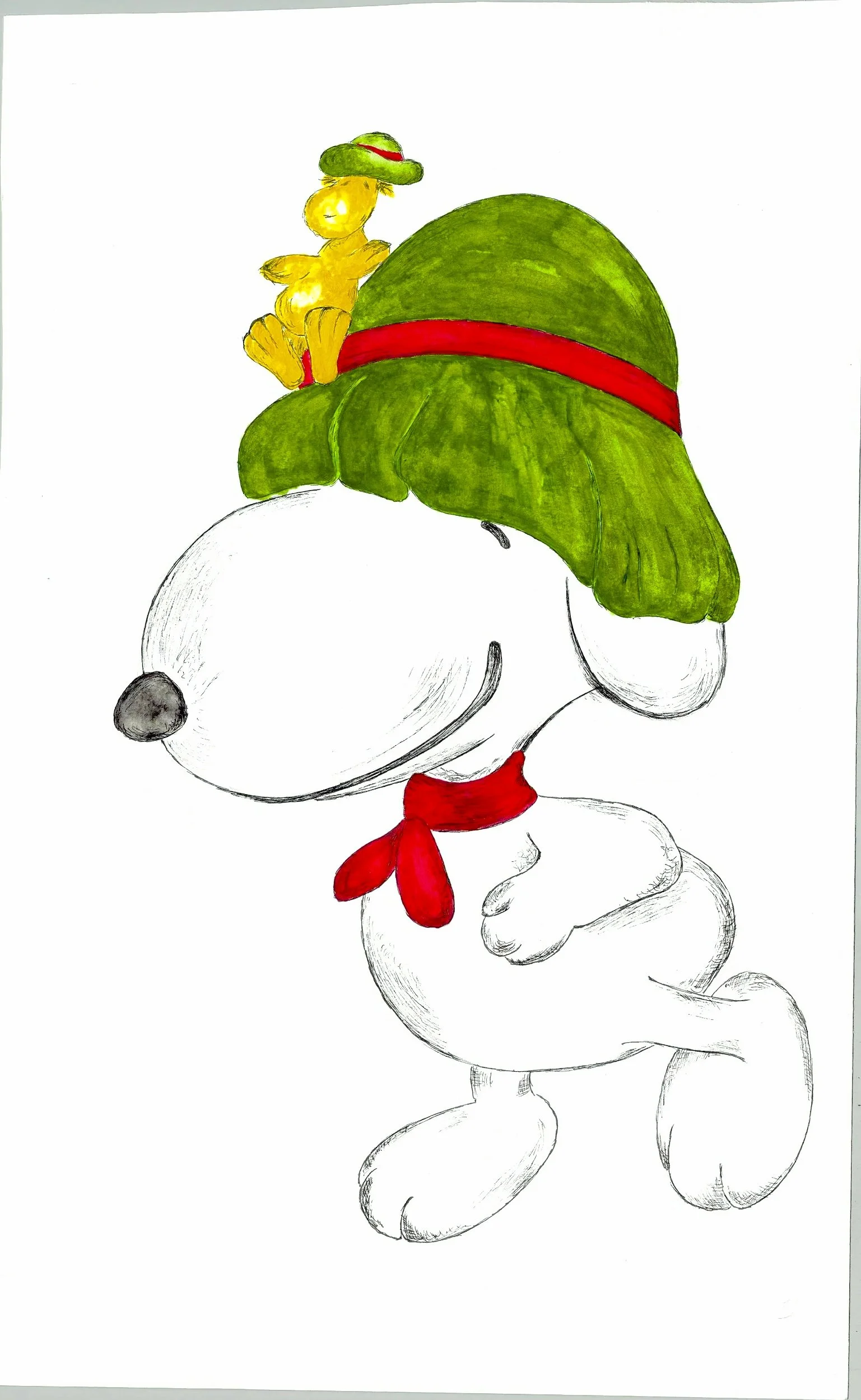
And there they were—balloons lined up in the street straight out of my childhood memories with Nana fifty years ago. Smokey the Bear led the parade, followed by new favorites: SpongeBob, the Pillsbury Doughboy, Snoopy—and some characters we didn’t even recognize.
Then, as if fate itself had guided us, we arrived at the one balloon I had been waiting for: Spider-Man. I had studied him endlessly in my art room in anticipation of this parade, imagining this very moment. To many, it might have seemed a ridiculous dream—especially for a 78-year-old on his birthday—but there he was, larger than life, hovering in the street – awaiting morning. Spiderman. What a gift.
We wandered the avenue, back and forth, stopping for pictures, then stopping again just to take it all in. It felt like a private backstage pass to Disney World, or a VIP tour of the Super Bowl—magical, improbable, unforgettable. And as we finally stepped away, still smiling, hand in hand, it was time to hail a cab, head to dinner, and join our family. The adventure had reached its perfect, improbable ending—another memory on the Road Less Traveled, proof that life, even at this age, could still surprise, delight, and reward the willing.